

Hey there,
Welcome to this week's issue of THE AI PARTNER. For independent professionals and small business operators, the most significant barrier to growth is rarely a lack of vision; it is a critical lack of time. This week's edition focuses entirely on maximizing that finite resource. Inside, explore a practical strategy for transitioning from a manual operator to an architectural multi-agent mindset, a spotlight on a voice-dictation tool that transcribes thoughts four times faster than human hands, a breakdown of how AI orchestration functions in practice, hand-picked articles published recently, and a highly customizable prompt to help design an automated ecosystem.
Featured Tip
Transitioning to a Multi-Agent Solopreneur Model
The traditional approach to scaling a solo enterprise involved hiring human assistants as operational capacity reached its limit. However, the current technological landscape allows solopreneurs to scale vertically by assembling a dedicated team of digital workers. Recent strategic research emphasizes that the most successful founders are actively offloading high-frequency, low-judgment tasks—such as inbox triage, scheduling, and initial customer onboarding—to specialized AI agents.
To implement this model effectively, start by identifying the most repetitive bottleneck in your weekly workflow. Instead of relying on a single, generalized large language model to answer every question, deploy narrow, highly specialized agents that handle specific lanes of work and pass context seamlessly to one another. This division of digital labor creates an automated ecosystem that operates continuously in the background, compounding efficiency. By keeping human expertise focused strictly on strategy, relationship building, and final approvals—the crucial 10-20% of work that actually drives growth—a one-person business can replicate the operational output of an entire administrative department.
Tool Spotlight
Tool of the Week: WISPR FLOW – Stop typing, start speaking

WISPR FLOW
For many professionals, manual typing is the primary bottleneck standing between strategic thought and business execution. Wispr Flow is a system-wide AI dictation tool that instantly transcribes natural speech into clean, formatted text across any desktop or mobile application—from Gmail and Slack to Notion and complex code editors.
Operating at speeds up to 220 words per minute, it fundamentally redefines how quickly communication can be executed. Unlike native operating system dictation features that capture every hesitation and error verbatim, Wispr Flow’s AI layer actively edits as you speak, stripping filler words and structuring paragraphs flawlessly.
The core features include real-time AI auto-edits, universal app integration, adaptive personal dictionary and voice snippet library. Its technical capability among others allow to automatically removes filler words ("ums"), corrects grammar, and formats syntax. It also functions natively in every operating system text field without plugins, learns proprietary industry jargon, client names, and specific acronyms. It can trigger saved templates and expansive text with short, predefined voice commands. The practical benefit for solopreneurs among others eliminates the need for manual proofreading and formatting of dictated text. It prevents context-switching and copy-pasting; operates seamlessly in the active workflow. Wispr Flow also ensures high transcription accuracy for niche consulting and specialized coaching terminology. It can also help to automate repetitive email replies, meeting links, and standard client updates instantly.
For coaches and consultants drafting lengthy client recaps, standard operating procedures, or complex proposals, integrating this tool reclaims hours of manual documentation every single week.
Infographic of the week
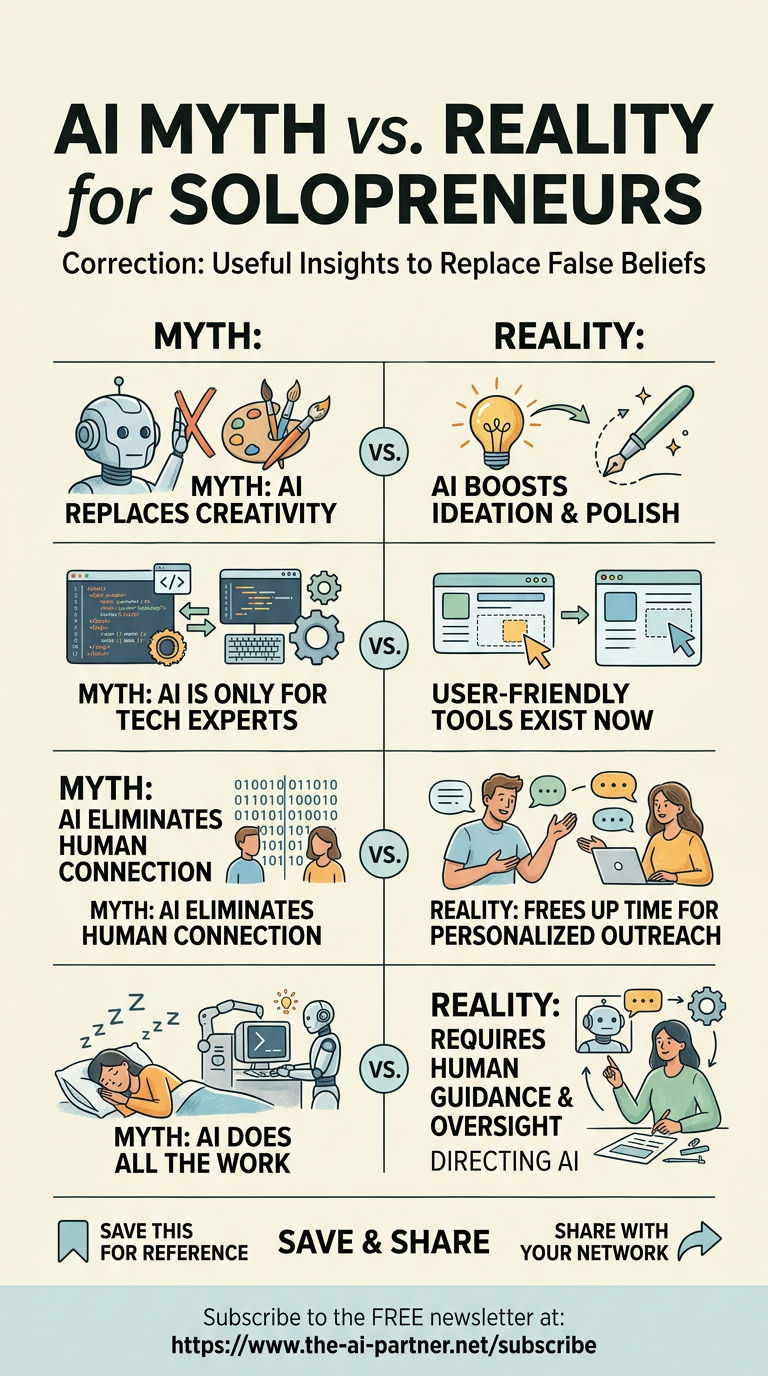
AI myth vs reality for solopreneurs
Every other day we find plenty of information about artificial intelligence (AI) and its impact on business. It is the most trending tech subject today but the problem is many of these content including many AI products promote myth rather than providing the reality. So, I decided to share an infographic for this week to separate some myths from reality. If you find this useful then save it for future reference and share it with like-minded buddies.
AI Vocabulary Corner

AI Orchestration
Term: AI Orchestration
Meaning: AI Orchestration refers to the technical coordination, management, and routing of multiple distinct artificial intelligence agents to execute a complex, multi-step workflow autonomously. Instead of a human operator manually prompting a single AI model for each sequential step, an orchestration layer acts as a digital "conductor." This layer ensures that specialized agents effectively pass contextual data to one another, enforce specific business policies, and trigger downstream tools with minimal human supervision.
Example: An independent marketing consultant establishes an AI orchestration workflow to handle inbound client acquisition. When a prospect submits a website inquiry form, the orchestration layer automatically triggers a specialized "research agent" to scan the prospect's corporate background. The gathered intelligence is securely passed to a "drafting agent" that synthesizes the data into a highly customized proposal outline. Finally, the orchestration system queues the completed draft directly in the consultant's email outbox, requiring only a brief human review and a single click to send.
Links Worth Reading
Here are a few essential reads published recently to help refine business strategies and deepen your understanding of AI integration:
AI Agents for Solopreneurs: Run a One-Person Company (2026) – A comprehensive exploration of how independent founders are assembling digital teams of AI agents to handle repeatable tasks, allowing them to reserve their energy strictly for strategy and relationships.
Solopreneur Tech Stack 2026: AI Tools for One-Person Business – Examines how the fundamental economics of scaling have shifted from hiring teams to deploying intelligent automation, effectively reducing operational costs for solo operators by up to 98 percent.
The State of AI Avatars 2026: How small businesses are scaling human presence – A new industry study revealing how trust-based professionals are utilizing AI avatars to distribute video content more frequently, overcoming camera fatigue while preserving audience engagement.
Beyond Adoption: The State of AI in Creative Work 2026 – Explores how freelancers and creative professionals are leveraging AI to accelerate speed and experimentation, utilizing the technology strictly as a creative co-pilot rather than a final deliverable generator.
AI Consulting Jobs: The 3 Doors in and Who Gets Hired in 2026 – An insightful look into how the market for freelance AI expertise is rapidly evolving, noting that clients are increasingly seeking complex, system-level automation rather than generic AI prompt outputs.
PROMPT OF THE WEEK
Design a Specialized "AI Orchestration" Workflow for Client Onboarding
To move beyond utilizing AI as merely a reactive writing assistant, use this prompt to help map out an automated, multi-agent workflow for one of your most critical business functions. Simply fill in the bracketed information with your specific operational details.
Act as an elite AI Systems Architect and Operations Expert specializing in workflow automation and AI orchestration for lean small businesses. My business is a [INSERT NICHE/BUSINESS TYPE, e.g., boutique digital marketing consultancy], and my primary operational bottleneck is the manual effort required to [INSERT BOTTLENECK, e.g., onboard new clients, extract data from discovery calls, and generate initial strategy documents].
I need to design a robust, automated AI orchestration workflow to handle this process. Please provide a step-by-step technical and strategic blueprint that includes:
1. Trigger Event: What specific digital action flawlessly initiates this automated sequence?
2. Agent Delegation: Break down the required process into 3 to 4 specialized "AI agents" (e.g., Data Extractor, Strategic Analyst, Editor). Describe the specific system instructions and strict focus area for each individual agent.
3. Contextual Data Handoff: Explain exactly how the output from one agent serves as the precise context and input for the subsequent agent.
4. Human-in-the-Loop Integration: Identify the critical decision node where I, as the business owner, must step in to review, adjust, and approve the final output before it reaches the client.
5. Recommended Tool Stack: Suggest 2 or 3 specific AI workflow automation platforms (e.g., Zapier, Make, n8n) that integrate securely together to build this system seamlessly today.
Ensure the final output is highly actionable, completely free of generic corporate fluff, and realistically executable by a solo operator possessing limited technical coding experience.
Closing note:
Thank you for reading this week's issue of THE AI PARTNER. The transition from working in your business to working on your systems is often challenging, but every step toward intelligent automation reclaims a critical fraction of your operational freedom. If you have any questions about implementing these workflows, want to share how you are using voice dictation in your daily routine, or have a specific topic you would love to see covered in the next issue, please click the survey button below and let me know. I read every single response and am always eager to shape future issues around the real-world challenges you face.
Warmly,
Alexandre G
Helping solopreneurs use AI better than before